
We have been studying material characterization with the ultrasonic micro-spectroscopy (UMS) technology using ultrasonic focused waves and ultrasonic plane waves in the VHF and UHF ranges. The UMS technology, in which the line-focus-beam ultrasonic material characterization (LFB-UMC) system plays a central role, analyzes and evaluates material properties.
At present, there are various kinds of analytical technologies using electron beams, x-rays, and laser beams, etc. particularly in the field of nano-technology. However, we have been proactively focusing on advantages of ultrasonic evaluation, and tackled technological problems unsolved by the conventional techniques. Figure1 shows the concept of the LFB-UMC system.
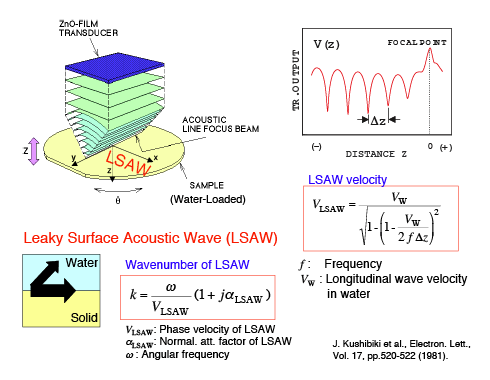
Fig. 1. The concept of the LFB-UMC system.
We have then proved the usefulness and effectiveness, achieving the highest accuracy in surface-wave velocity measurement. Features of the system are as follows:
1. Perfect directionality of the LFB ultrasonic device
We developed this ultrasonic method, using a wedge-shaped focused wave, and established a method of making quantitative materials characterization using V(z) curve analysis. We can detect anisotropy of materials as a function of wave propagation direction.
2. High measurement accuracy
Our system permits the phase velocity measurements of leaky surface acoustic waves (LSAW) excited and propagated on a water-loaded specimen surface.
Measurement accuracy: ±0.001% (relative), ±0.01% (absolute)
3. Nondestructive and non-contact evaluation
Our system permits nondestructive and non-contact measurements because of using pure water as a couplant for a specimen surface.
4. Extremely sensitive detection of chemical composition inhomogeneity in materials
We can obtain the specific information about the chemical compositions on materials surface with extreme sensitivity through the LSAW velocity measurements.
5. Inspection for small area and large scanning area
We can measure the distribution of micro elastic characteristic on substrate surface in a smaller measurement region of 0.5 mm2 for a scanning area of much larger than 200 mm×200 mm.
6. Desired wave propagation direction for anisotropic materials and properties
We can choose a desired wave propagation direction, suitable for characterization and evaluation.