Digital Twin of Life Systems
The human body is maintained by tens of trillions of cells that exchange information and work together. However, it remains difficult to understand how the behavior of individual cells leads to the functions of tissues and organs.
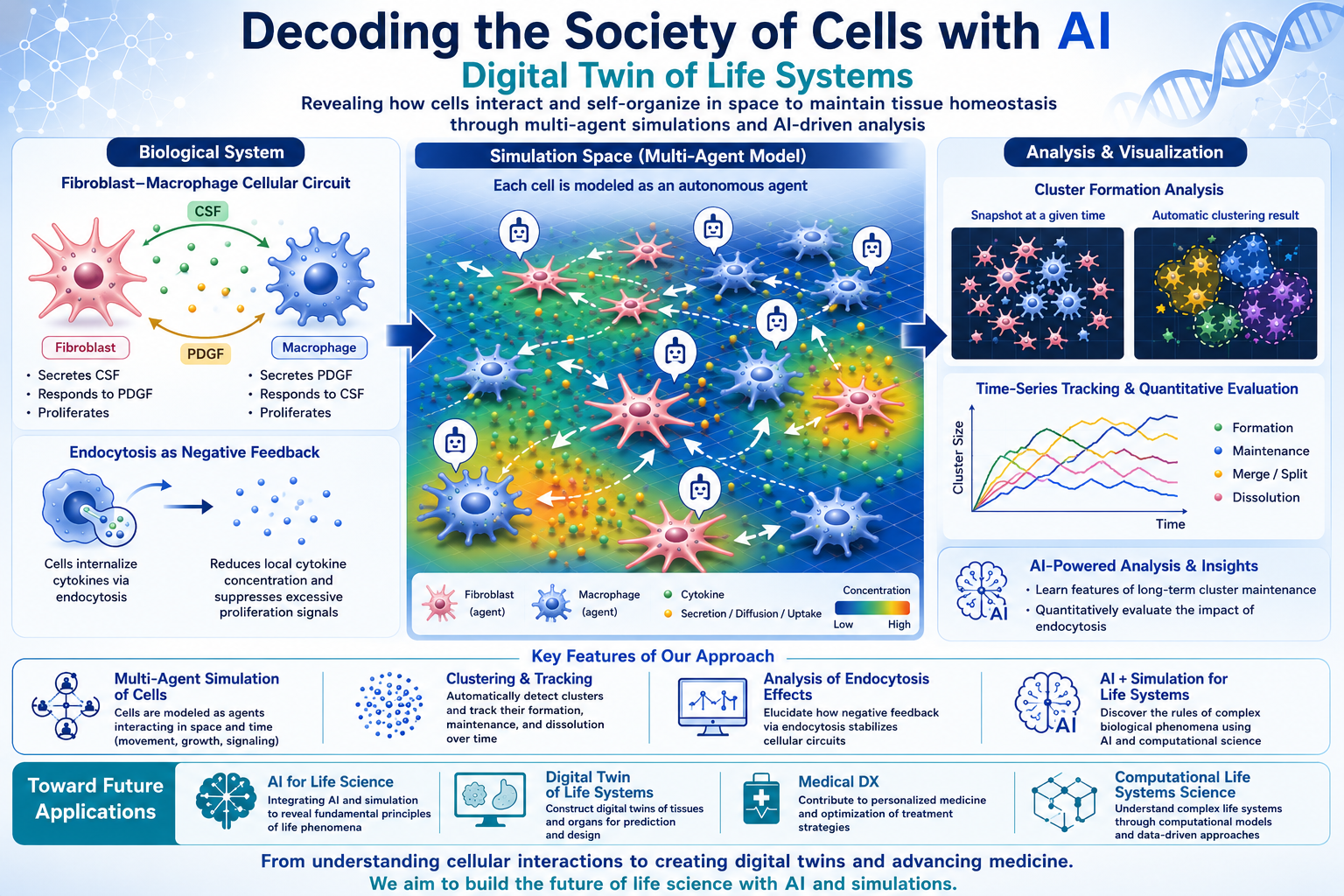
Hariyama Laboratory models cells as autonomous agents and simulates the behavior of biological tissues on a computer. This approach helps us study how cellular communities form, persist, and change over time.
Fibroblasts and macrophages are represented as agents that move, grow, and interact with each other.
Cytokine secretion, diffusion, uptake, and negative feedback are modeled as rules of cellular society.
Large-scale simulation outputs are analyzed using AI, clustering, and time-series analysis.
Modeling Rules of Cell Society
We focus especially on interactions between fibroblasts and macrophages, which are important for maintaining tissue homeostasis. By modeling cytokines and feedback mechanisms, we investigate how cellular groups emerge and remain stable.
AI-Based Analysis and Visualization
Simulation produces large amounts of data. We use AI and clustering analysis to automatically evaluate the formation, maintenance, and disappearance of cell clusters, and to quantify dynamic patterns in the simulated tissue.
Future Applications
This research aims to contribute to digital twins of biological tissues and to future applications in AI life science, medical DX, drug discovery, regenerative medicine, disease mechanism analysis, and computational life systems science.
- AI life science
- Medical DX
- Drug discovery support
- Regenerative medicine
- Disease mechanism analysis
- Computational life systems science