
AI for Clinical Decision Support
Modern healthcare accumulates large volumes of data, including electronic medical records, laboratory tests, medical images, and body composition measurements. These data are valuable but challenging: sample sizes can be limited, missing values are common, individual differences are large, and clinical accountability is essential.
Hariyama Laboratory develops AI methods that combine predictive accuracy with interpretability, enabling physicians to understand and use analytical results in diagnosis, treatment planning, and patient care.
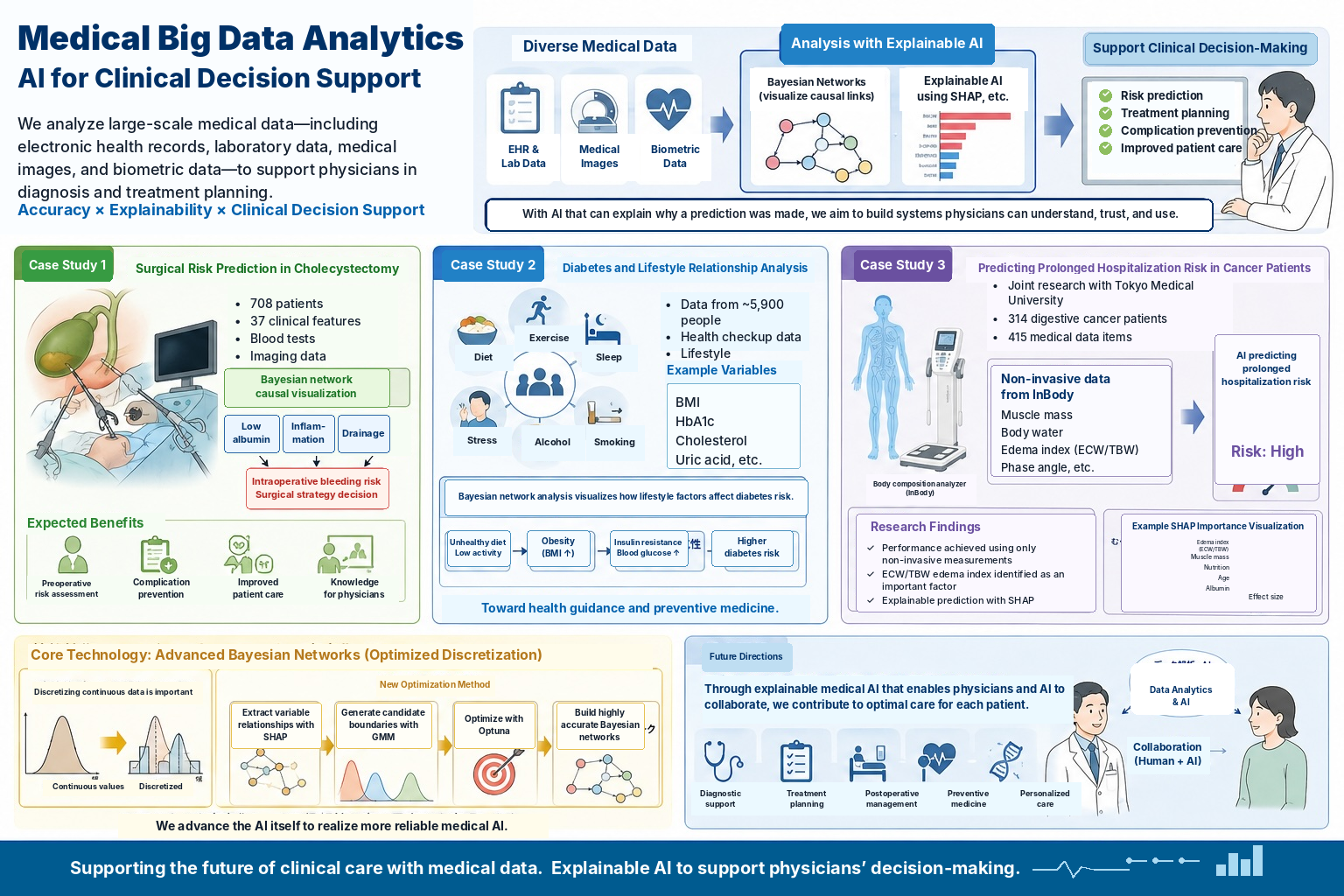
Clinical records, laboratory values, images, and sensing data are organized for analysis.
Bayesian networks, SHAP, tree-based models, and probabilistic models are used to identify important factors.
Risks and decision factors are presented in a way that clinicians can interpret and discuss.
Explainable AI
In medicine, it is not enough for AI to make a prediction. Clinicians also need to understand why the prediction was made. We use explainable AI techniques to build models that can reveal relationships among variables and provide clinically meaningful insight.
Case Study 1: Surgical Risk Prediction in Cholecystectomy
For gallbladder disease with severe inflammation or fibrosis, surgeons must decide whether to continue laparoscopic surgery, convert to open surgery, or perform partial resection. We build Bayesian network models from patient data, clinical features, blood test values, and imaging information to visualize factors related to intraoperative bleeding and surgical strategy.
- Preoperative risk assessment
- Prevention of complications
- Improvement of patient care
- Discovery of new clinical insights
Case Study 2: Relationship Analysis Between Diabetes and Lifestyle
Diabetes is influenced by many lifestyle factors, such as eating habits, exercise, sleep, stress, alcohol consumption, and smoking. We integrate health checkup data and lifestyle questionnaires and analyze relationships among BMI, HbA1c, cholesterol, uric acid, and other indicators.
Bayesian network analysis helps visualize how lifestyle factors may influence diabetes risk, with potential applications in health guidance and preventive medicine.
Case Study 3: Predicting Prolonged Hospitalization Risk in Cancer Patients
Prolonged hospitalization has a major impact on hospital management and patient quality of life. In collaboration with Tokyo Medical University, we analyze medical data from gastrointestinal cancer patients, including non-invasive body composition measurements.
Features such as muscle mass, body water, edema indicators, and phase angle are used to predict prolonged hospitalization risk before surgery, and SHAP is used to explain important factors.
Platform Technology: Bayesian Networks and Optimization
We also study methods for improving AI itself. For Bayesian networks, discretizing continuous data appropriately is important. We combine SHAP-based relationship extraction, Gaussian mixture models, and optimization techniques such as Optuna to build more reliable Bayesian network models.
Future Direction
AI is increasingly used for diagnosis support, treatment planning, postoperative management, preventive medicine, and personalized medicine. Our goal is to develop explainable medical AI that works together with clinicians, discovers new knowledge from medical big data, and contributes to better patient quality of life.