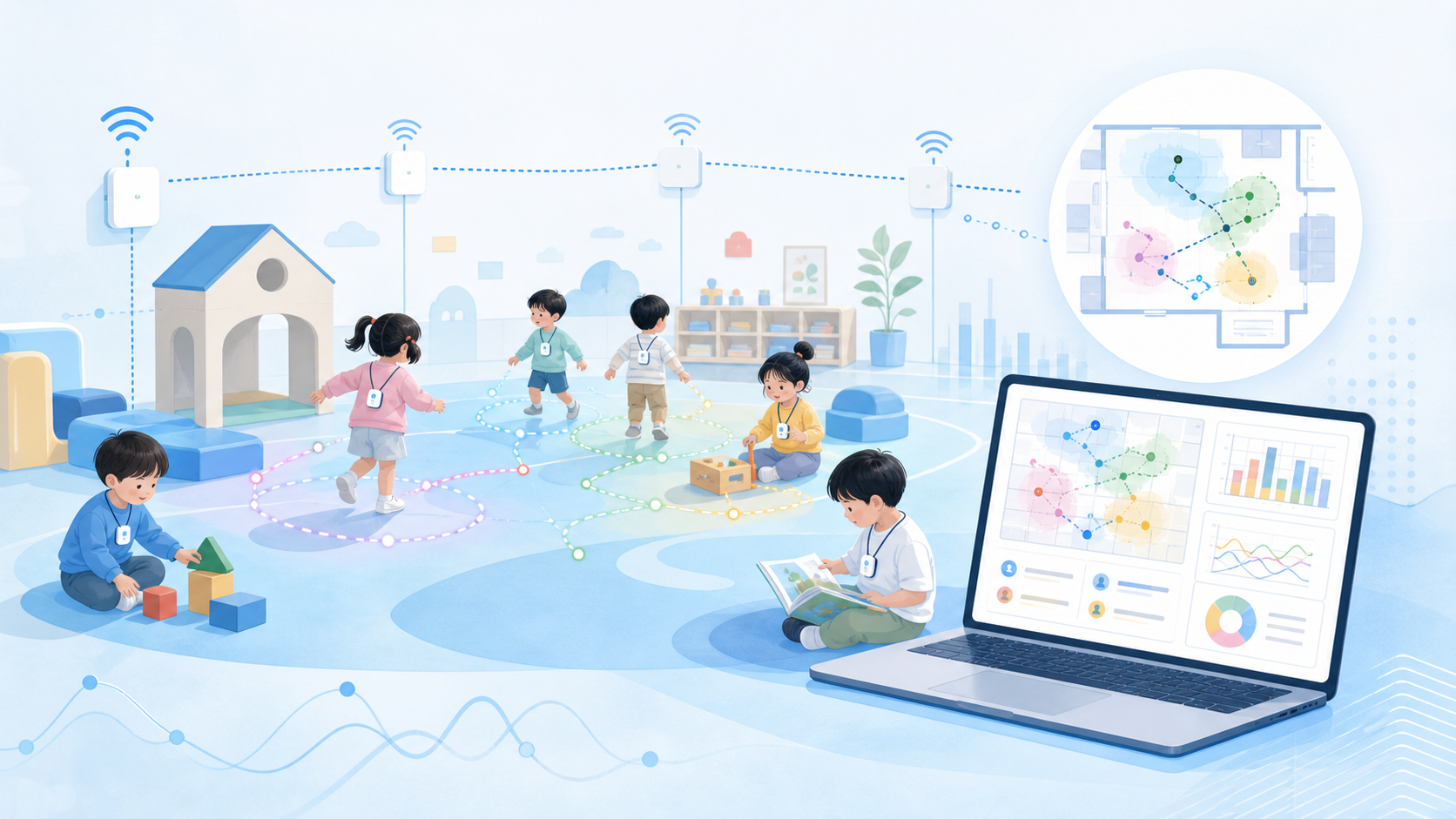
Understanding Child Development with AI and Sensing
Every child has different interests, personalities, and developmental characteristics. In childcare and educational environments, however, it is difficult to observe many children continuously and objectively at the same time.
We develop a multi-person measurement system using small wireless tags to automatically record when, who, and where children are during play. By applying AI and data science, we analyze play preferences and social relationships in a quantitative way.
Our long-term goal is to build a developmental digital twin that integrates location, video, audio, and body activity data to support each child's growth.
Multi-Person Sensing System
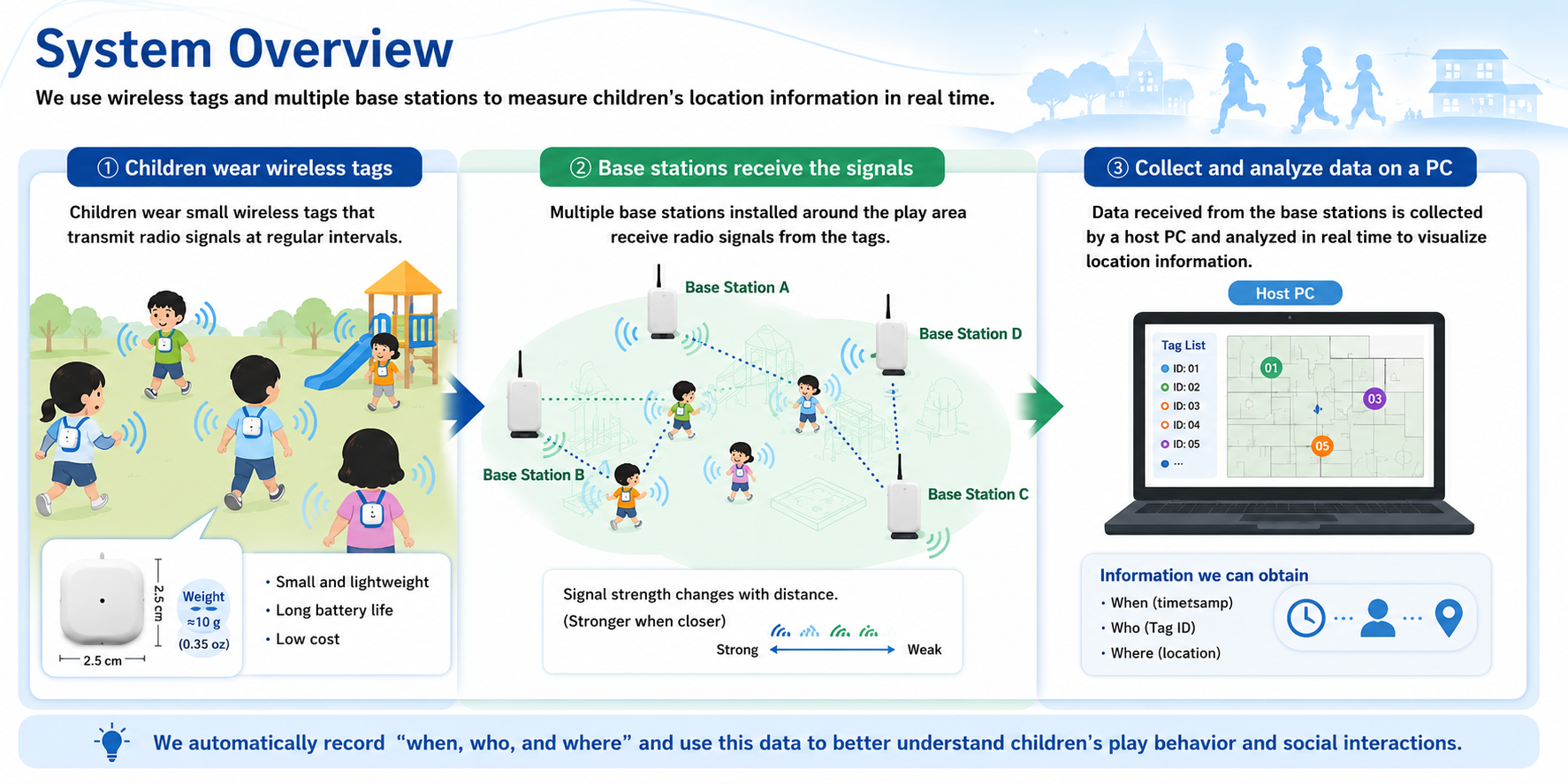
Children wear small wireless tags, while multiple base stations installed in the play area receive radio signals from the tags. The system estimates each child's location based on received signal strength.
By optimizing the base-station program, the system can measure up to around 50 children simultaneously in real time, making it possible to objectively record children's movement and play behavior.
Analysis of Play Preferences
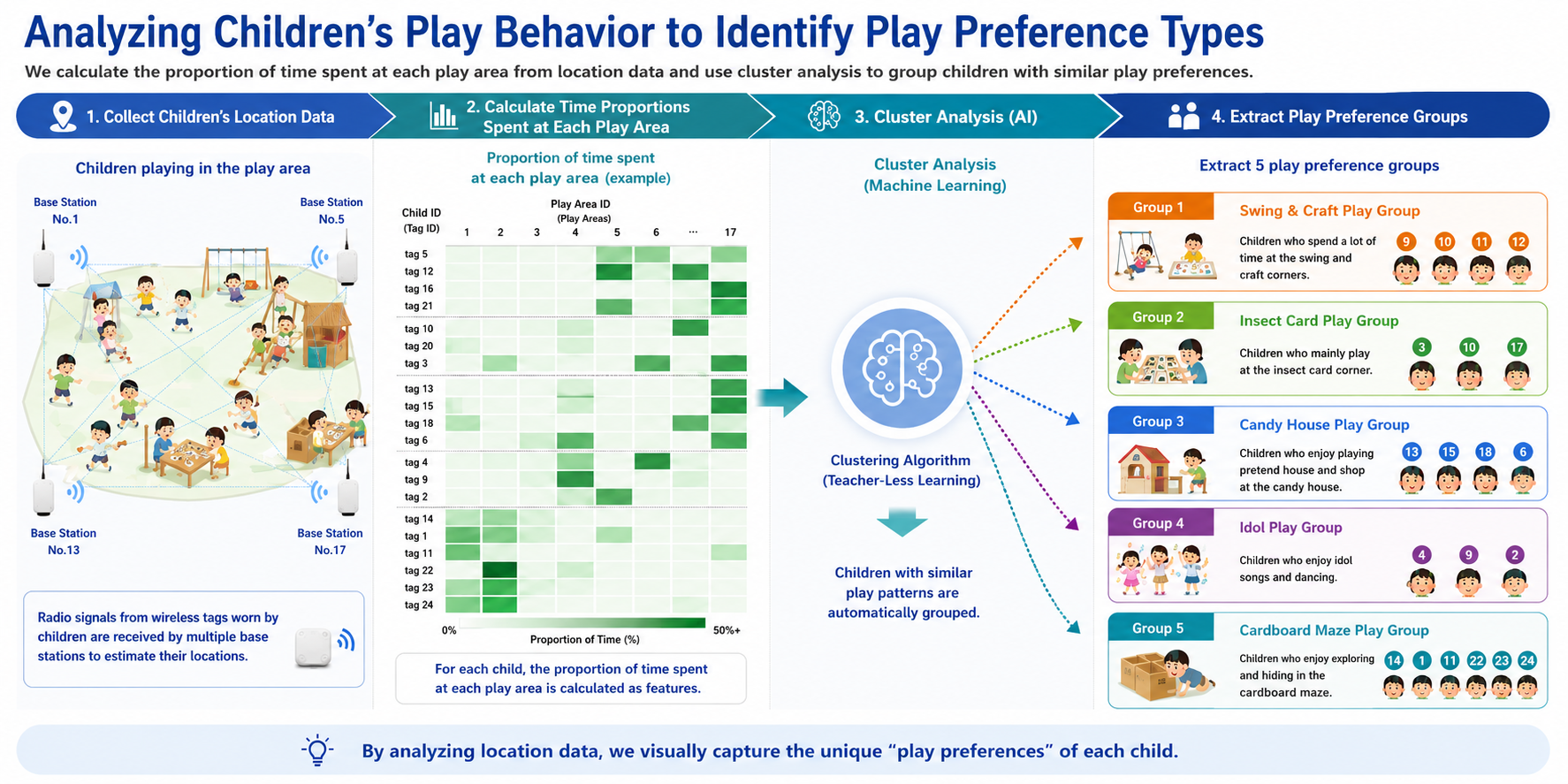
From location data, we calculate how much time each child spends in each play area. Clustering analysis then groups children who show similar play preferences.
This approach helps reveal individual interests such as swing play, craft activities, card games, pretend play, and maze-like exploratory play. The results can inform childcare support and improvements to play environments.
Analysis of Social Relationships

We estimate how long children stay together in the same area and analyze the resulting relationship network. In the network, each child is represented as a node, and shared time represents the strength of the relationship.
This makes it possible to visualize friend groups, play communities, children with fewer interactions, and relationships between children and caregivers. The analysis supports an objective understanding of group dynamics and social development.
Toward a Developmental Digital Twin
We are working toward a next-generation platform for understanding child development: a developmental digital twin.
By integrating location data, physical activity, video, audio, and AI-based behavior understanding, we aim to recreate children's interests, sociality, and developmental changes in a digital space.